Leaning Tree: When to Worry and What to Do in Georgia
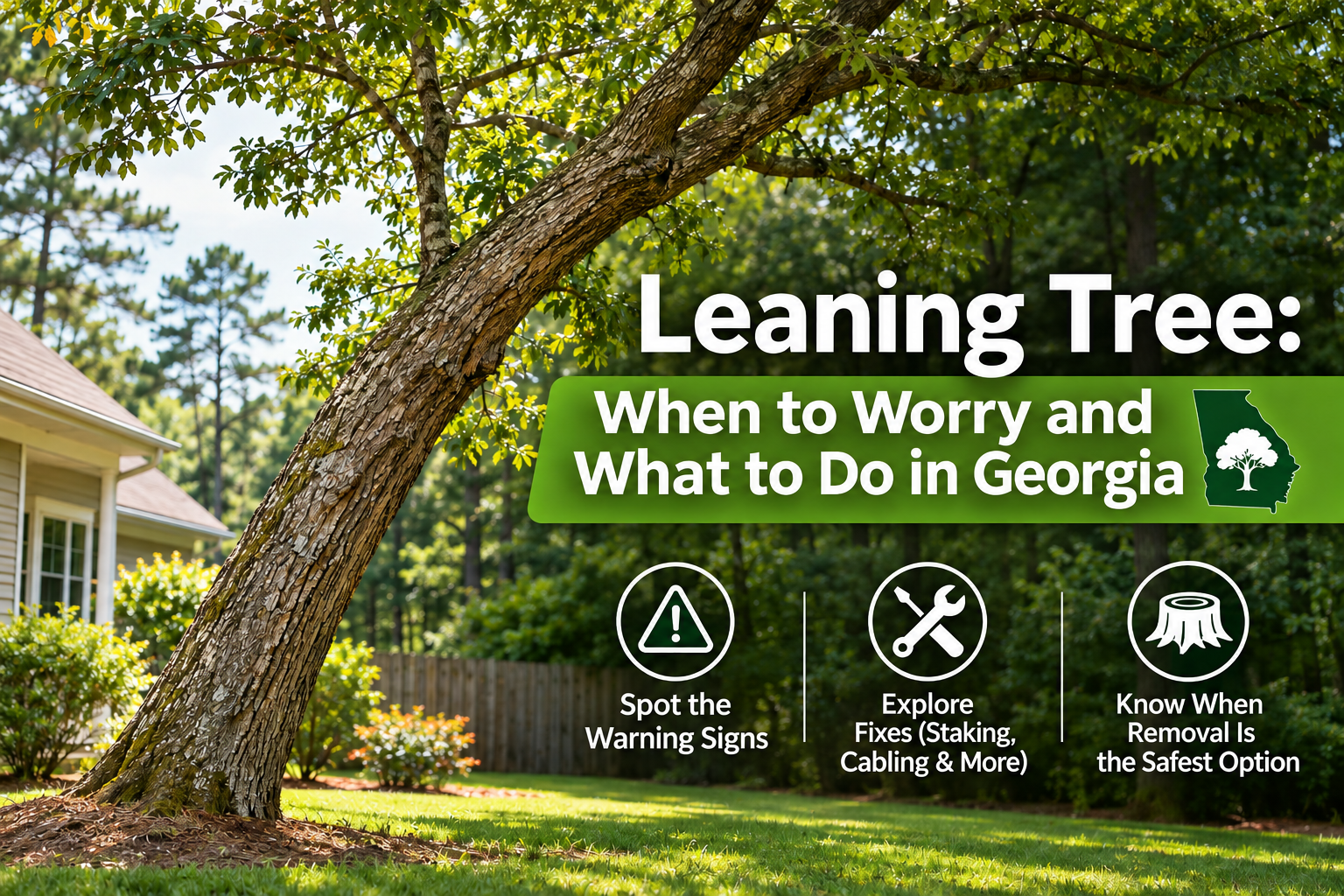
A leaning tree is one of the most common worries we hear from homeowners across metro Atlanta, and winter is when it matters most. Heavy rain soaks our red clay, gusty winds and the occasional ice storm push on the canopy, and a tree that looked fine in summer can start to tip toward your roof almost overnight.
The good news is that many leaning trees are perfectly safe. The key is knowing the difference between a tree that grew with a lean and one whose roots are starting to fail. This guide explains when to worry, how to check a leaning tree yourself, and what can be done to fix it.
Why Trees Lean in the First Place
Trees lean for two very different reasons, and the cause tells you a lot about the risk.
- A natural lean. Many trees slowly grow toward sunlight, especially along wooded lot lines or under taller neighbors. These trees usually have a gentle curve in the trunk, and their roots grow stronger on one side to balance the weight.
- A lean caused by root trouble. A tree with a straight trunk that suddenly tilts usually has a problem below ground. Storm damage, saturated soil, root rot, construction damage or trenching for utilities can all weaken the root plate that anchors the tree.
Georgia’s clay soil adds its own challenge. Most of a tree’s roots grow in roughly the top 16 inches of clay, so when that layer turns to mud after days of rain, a tree loses much of its grip. UGA Extension notes that when the ground is saturated and soft, trees are easily uprooted, which is why so many trees come down when heavy rain is followed by high winds.
Is a Leaning Tree Dangerous? When to Worry
A lean on its own isn’t a reason to panic. What matters is whether the lean is changing and what the tree would hit if it fell. UGA Extension considers a tree that leans 30 degrees or more, with a target in its path, to be hazardous. Watch for these warning signs:
- The lean is new, or it has gotten worse since last season
- Cracked, lifted or mounded soil on the side opposite the lean
- Roots pulling up out of the ground, or a gap opening between the trunk and the soil
- Mushrooms, conks or soft, crumbly wood at the base of the trunk
- Cracks, splits or buckled bark along the trunk
- Dead branches or thinning leaves on one side of the canopy
- Your home, garage, driveway, fence or power lines sit in the direction of the lean
Mushrooms at the base deserve extra attention. According to UGA Extension, by the time fungi appear on the trunk or root flare, the tree is usually in an advanced stage of decay, and wood decay can’t be cured. If you’re unsure whether the tree is still healthy, our guide on how to tell if a tree is dead walks through more signs to look for.
How to Check a Leaning Tree Yourself
You don’t need to climb anything to do a basic check. Most of what you need to know is at ground level.
- Take a photo from a fixed spot. Stand in the same place each time and photograph the whole tree. Comparing photos over a few weeks, or after each storm, is the simplest way to see if the lean is changing.
- Walk around the base. Look for cracked or heaving soil, especially on the side away from the lean. A raised mound there means the root plate may be tipping.
- Check the trunk. Note any cracks, cavities, oozing or loose bark, and look for mushrooms near the ground.
- Look up at the canopy. Dead limbs, broken branches hanging in the crown, or a lopsided canopy add weight and risk.
- Map what’s in the way. Picture the tree falling in the direction it leans. If it could reach your house, a car, a play set or a power line, the stakes are higher.
If any of these checks turn up warning signs, schedule a professional hazardous tree assessment. A certified arborist can measure the lean, test for hidden decay and tell you whether the tree can stay.
How to Fix a Leaning Tree: Your Options
The right fix depends on the tree’s age, size and the health of its roots.
Young trees: straighten and stake
A recently planted tree that has started to tip can usually be straightened and staked. Use wide, soft ties set low on the trunk so the tree can still sway a little, which helps it build strength. Extension guidance across the Southeast agrees that stakes should generally come off after about one growing season, because leaving them on longer can weaken or girdle the trunk.
Mature trees: reduce weight and add support
You generally can’t pull a mature tree back upright. Its roots and wood have already grown around the lean, and forcing it can tear the roots that are holding it in place. If the roots and trunk are sound, an arborist can make it safer instead:
- Crown reduction and selective pruning. Removing weight from the heavy side of the canopy reduces the force pulling the tree over. Our tree trimming services in Atlanta include this type of corrective pruning.
- Cabling and bracing. Steel cables and rods installed high in the canopy support weak branch unions and split trunks, and can reduce strain on a tree with a moderate lean.
- Soil and root care. Improving drainage, avoiding compaction and keeping heavy equipment off the root zone help the tree hold on.
Timing matters for this work, too. Late fall and winter are a good window for corrective pruning on many trees, as we explain in our guide to the best time to trim trees in Georgia.
When a Leaning Tree Needs to Come Down
Removal is the safest choice when:
- The lean appeared suddenly or is still moving
- The root plate is lifting or the roots are visibly broken
- There is significant decay in the base, trunk or major roots
- The tree leans toward your home or another structure and can’t be stabilized
- The tree is dead or dying
Never try to cut down a leaning tree yourself. A leaning trunk is under heavy tension and can split, kick back or fall in an unexpected direction once it’s cut. Our crews use controlled rigging to take leaning trees down in sections, and our tree removal services in Atlanta include full cleanup. If you’re budgeting for the job, here’s what affects tree removal cost in Atlanta.
Tree Leaning After a Storm? Act Fast
A tree that tips during or after a storm is the most dangerous kind of leaning tree, because its roots have just moved and the soil is still soft. Keep children, pets and cars out of its path, stay well clear of any downed lines, and don’t wait for the next rain to see if it settles. Our storm damage tree services team responds 24/7 to leaning and fallen trees across Gwinnett County and metro Atlanta.
Tall pines deserve a quick mention. A leaning pine tree deserves a professional look, especially near the house, since tall pines carry much of their weight high in the crown where the wind hits hardest. If you’re not sure what kind of tree you have, our guide to popular pine trees in Atlanta can help you identify it.
Frequently Asked Questions
Is a leaning tree dangerous?
Not always. A tree that has leaned the same way for years and has firm soil, a solid trunk and no decay is often stable. A leaning tree becomes dangerous when the lean is new or getting worse, when the soil is cracking or lifting at the base, or when a house, driveway or play area sits in its path. UGA Extension considers a tree leaning 30 degrees or more with a target in its path to be hazardous.
Can you straighten a leaning tree?
Young, recently planted trees can often be straightened and staked, as long as the stakes come off after about one growing season. Mature trees generally can’t be pulled back upright, because their roots and wood have already grown around the lean. For a large tree, the real options are reducing weight with pruning, adding support with cabling and bracing, or removing it.
How do I know if my tree is about to fall?
Look at the base, not the top. Warning signs include soil cracking or heaving on the side opposite the lean, roots lifting out of the ground, a gap between the trunk and the soil, mushrooms or soft wood near the base, and new cracks in the trunk. If you see any of these, stay out from under the tree and call a professional right away.
Why is my tree suddenly leaning after a storm?
Heavy rain softens the soil, and strong wind then pushes on the canopy until the root plate shifts. Trees with shallow, damaged or decaying roots are the most likely to tip. A tree that starts leaning after a storm should be treated as an emergency until a professional has checked it.
Who should I call about a leaning tree near power lines?
Never try to cut, brace or push a tree that is touching or leaning into a power line. Stay well away from it, call your utility company first, and then call a professional tree service to handle the tree once the line is safe.
Get Your Leaning Tree Checked in Gwinnett County
If a leaning tree is keeping you up at night, you don’t have to guess. Avalon Tree Services is a locally owned tree company based in Lilburn, serving homeowners and businesses across Gwinnett County and Greater Atlanta, including Lawrenceville, Snellville, Duluth, Norcross, Suwanee and Buford. Our certified arborists will tell you honestly whether your tree can be saved or needs to come down.
Call 770-415-8581 or request your free estimate today. If a tree is leaning toward your home right now, call us any time for 24/7 emergency service.
Jose Roman is the owner of Avalon Tree Services and a member of the Georgia Green Industry Association (GGIA member #68916703). He leads the crews behind every tree removal, pruning job and storm cleanup we do across Gwinnett County and metro Atlanta, working out of our home base in Lilburn. Jose reviews the advice on this site so it lines up with what we actually see in Georgia yards: tall loblolly pines, aging water oaks and red clay that turns to mud after a week of rain.